


By Chris Felico
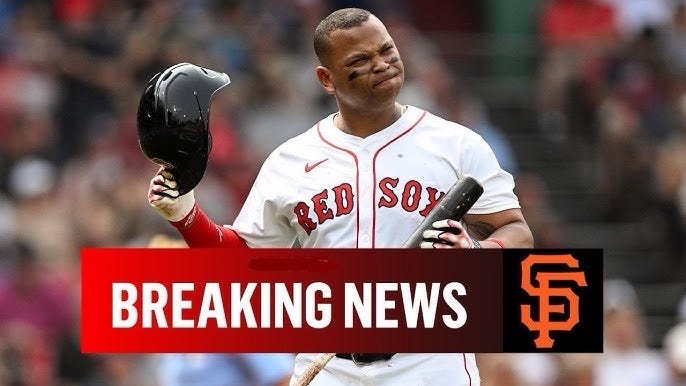
Just hours after sweeping the Yankees and clawing back into the playoff picture with momentum and optimism, the Boston Red Sox shocked the baseball world by dealing away the face of their franchise—again.
This time, it’s Rafael Devers, the highest-paid player in Red Sox history and the supposed cornerstone of their next contending era. Devers, 28, was shipped to the San Francisco Giants (a team the Red Sox play in the coming week) in a move that sent shockwaves through Fenway and beyond. In return, Boston received a package centered around LHP Kyle Harrison, a talented left hander, who was once a top pitching prospect, along with right-hander Jordan Hicks, RHP Jose Bello, and, maybe the next most enticing piece in the deal behind Harrison, OF prospect James Tibbs. On paper, the return is uninspiring for a player of Devers’ caliber.
If this feels familiar, it should. It was just five years ago that the Red Sox traded away Mookie Betts, a generational talent and MVP, to the Los Angeles Dodgers for a return that, in hindsight, amounted to almost nothing. Alex Verdugo was inconsistent before being shipped out. Jeter Downs was a complete bust. Connor Wong is a solid backup catcher. And that’s it.
Now, history has repeated itself—only this time, it’s even harder to understand the timing.
Boston is 37-36 after the sweep of the Yankees. Garrett Crochet is pitching like an ace. Brayan Bello just shut down the Yankees with 7 scoreless innings and 8 strikeouts, including three against Aaron Judge. The team finally seems to have found a rhythm, a rotation core, and the backbone of a potential second-half run. And then this?
The Identity Crisis
To be fair, trading Devers isn’t entirely indefensible. While his bat has remained strong (.282, 15 HR, .875 OPS in 2025), his inability—or unwillingness—to lead or adapt has become increasingly evident. Sources have said Devers grew frustrated after the Sox signed Alex Bregman in the offseason, viewing the move as a threat to his standing. He reportedly resisted the idea of becoming a full-time DH, despite the move being in the team’s best interest both defensively and structurally.
That reluctance only furthered the narrative that Devers, while immensely talented, couldn’t provide the identity or leadership Boston desperately needed. The team has been searching for a new face of the franchise since Betts was traded, and despite the size of Devers’ contract (10 years, $313.5 million), he never quite stepped fully into that role.
So yes, from a cultural and clubhouse standpoint, moving on may have made sense.
But why now—in the middle of a playoff push, when the roster finally feels competitive again? Why not wait until the offseason, when more bidders might emerge? Why not demand a better return? Or better yet: why sign Devers to a record-breaking deal at all just to trade him 18 months later?
Déjà Vu All Over Again
The most damning part of all this? It’s happening again—under nearly identical circumstances.
In 2020, it was first-time GM Chaim Bloom who made the fateful Betts trade. Now, it’s Craig Breslow, another first-time head of baseball operations, overseeing the departure of a second franchise cornerstone. John Henry and Red Sox ownership have once again entrusted an inexperienced executive to pull the trigger on a seismic move with franchise-altering consequences.
And once again, the return feels woefully insufficient.
Kyle Harrison was once a talented pitching project in baseball, but has failed to put it all together in the majors, in which he was immediately optioned to AAA Worcester by the Red Sox.
Jordan Hicks a pitcher (who’s currently injured) that the Giants tried to have be a starter, but failed in that role, and will inevitably be a reliever.
Jose Bello, a minor league reliever who’s essentially a non-impact fluff piece to this trade.
James Tibbs, the #4 overall prospect for the Giants, and probably the most intriguing player in this trade. However, he was also an OF prospect that if Craig Breslow coveted so much he could’ve taken him ahead of other OF prospect, Braden Montgomery, in last year’s MLB Draft (Montgomery was dealt to Chicago in the Crochet deal).
None of these players project as surefire major league contributors, let alone impact stars.
So… What Now?
This trade raises a thousand questions. Is this truly a retool, or a quiet reset? Is there any possible version of this deal that can turn out well for the Red Sox in the long run? Will fans stick around through yet another undefined rebuild?
And most of all: how many more cornerstones have to be traded before the Red Sox finally figure out who they are?
Maybe Rafael Devers was never the franchise player the Sox hoped he’d be. Maybe he didn’t want to be. But once again, the Red Sox are left without a clear identity—and with a return package that offers little immediate or long-term hope.
The 2025 Sox have shown signs of life lately. They’ve proven they can beat good teams, and that they may be trending upward. But the trade of Devers leaves a gaping hole in the heart of the clubhouse, and a fanbase wondering—again—why do we keep doing this?
So now we ask, just like we did in 2020:
Where do the Red Sox go from here? And is there any chance this turns out well?
Fenway waits. Again.