


By Chris Felico
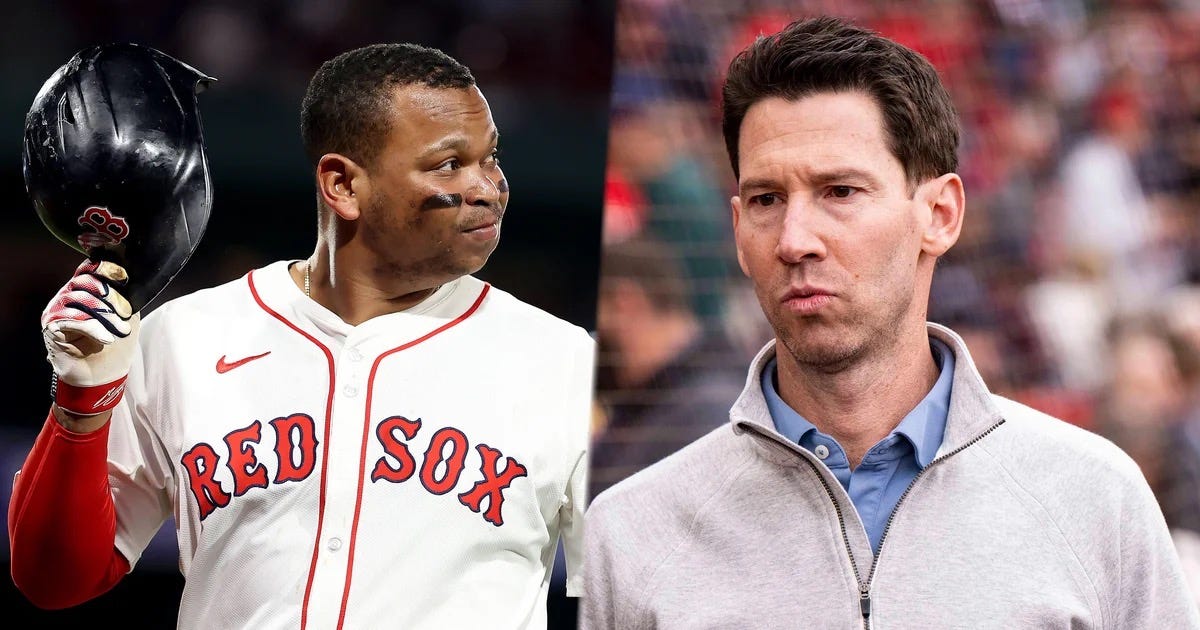
The Boston Red Sox won their first series without Rafael Devers, taking two of three from the Seattle Mariners on the road and nudging themselves into a Wild Card position. It was a statement series—not just in terms of standings, but in terms of resilience. For a team that had just traded away its franchise cornerstone mere days after sweeping the Yankees, it could’ve easily unraveled. Instead, the Red Sox responded with focused, competitive baseball.
But while the on-field product showed signs of stability, off the field, the fan base is anything but united.
The controversial trade that sent Devers to the San Francisco Giants in exchange for a modest return of righty Jordan Hicks, lefty Kyle Harrison and a pair of prospects in outfielder James Tibbs III (Giants No. 4 prospect at the time of the deal) and righty Jose Bello. has fractured Red Sox Nation. And as the team pushes deeper into the playoff race, that division only seems to be growing louder.
Camp One: Blame Breslow and Ownership
A large portion of fans remain furious with Chief Baseball Officer Craig Breslow and, by extension, Red Sox ownership. This camp believes Devers’ exit was a direct result of mismanagement, poor communication, and a lack of long-term vision from the top.
Many point to the awkward handling of Devers' role—particularly the shift toward designating him as a full-time DH after the signing of Alex Bregman—and feel the front office failed to foster a respectful and transparent relationship with a player who, just 18 months ago, signed the largest contract in franchise history.
To them, Devers didn’t walk away—he was pushed out.
They also argue that trading a 28-year-old All-Star bat while the team was on a playoff push sends the wrong message to both the clubhouse and the fan base. The fact that Devers was pulled off the team plane just hours after the team’s emotional sweep of the Yankees only intensified that sentiment. Even for those who might understand the logic of trading him eventually, the timing felt tone-deaf and deflating.
And most importantly, they ask: If you’re going to trade Rafael Devers, how is this all you got?
Camp Two: Devers Shares the Blame—But Timing Still Baffles
On the other side are fans who believe that Rafael Devers holds some responsibility for the breakdown. They’ve grown weary of seeing star players—Mookie Betts, Xander Bogaerts, and now Devers—failing to take full accountability for their roles in difficult situations. This camp argues that Devers' reported resistance to becoming a DH, even when it was the best move for the team’s defensive outlook, showed a lack of adaptability and leadership.
In their view, it’s not unreasonable to expect a franchise player to put team needs above personal preference—especially one making over $300 million.
However, even these fans aren’t thrilled with Breslow. Most agree that the trade return was underwhelming for a player of Devers’ caliber and contract control, and the idea of moving him mid-season, during a playoff race, feels—to them—like poor planning at best and organizational sabotage at worst.
They see logic in a soft reset, but question why that reset wasn’t handled during the offseason when more teams may have been in the market, and pressure wasn't so high.
The Path Forward: Does One Exist?
With Boston sitting at 39-37 and currently holding a Wild Card spot, the question now becomes: What comes next?
If there’s a rational justification for the Devers trade, it lies in the idea that it frees up both financial resources and prospect capital. Devers’ departure removes a massive long-term salary from the books. The return—though modest—adds some depth to a farm system that’s already improved under Breslow’s watch.
But intent is meaningless if action doesn’t follow. If the Red Sox don’t reallocate that money into acquiring controllable talent or extending emerging core players, the trade becomes even harder to defend. If Harrison, Hicks, Tibbs III, and Bello (Jose not Bryan) never pan out—and Boston fails to replace Devers’ offensive production—this move could become the defining failure of the Breslow era.
On the other hand, if Boston’s front office uses the newfound flexibility to add legitimate pieces—whether that’s a young starting pitcher, a controllable middle-of-the-order bat, or long-term bullpen reinforcements—this could be viewed in hindsight as a necessary, if painful, pivot toward sustainable success.
Can Both Be True?
What makes the Devers discourse so complicated is that both camps may be partially right.
Yes, Rafael Devers didn’t always rise to the level expected of a franchise face. Yes, Craig Breslow’s return package feels light. And yes, the timing of the trade could not have been worse from a momentum and morale standpoint. But none of those truths necessarily cancel each other out.
Now, the Red Sox are at a critical crossroads. The team is winning—without Devers—and proving more resilient than many expected. But winning in June doesn’t erase years of instability or silence the legitimate questions still echoing from this franchise-altering deal.
The question isn't just whether the Red Sox can keep winning this year. The real question is:
Will this front office do what's necessary to justify such a massive gamble?
If they do, maybe this fractured fan base can rally around a new vision. If they don’t, this will be remembered not as the beginning of something—but as the end of something that could’ve been great.