


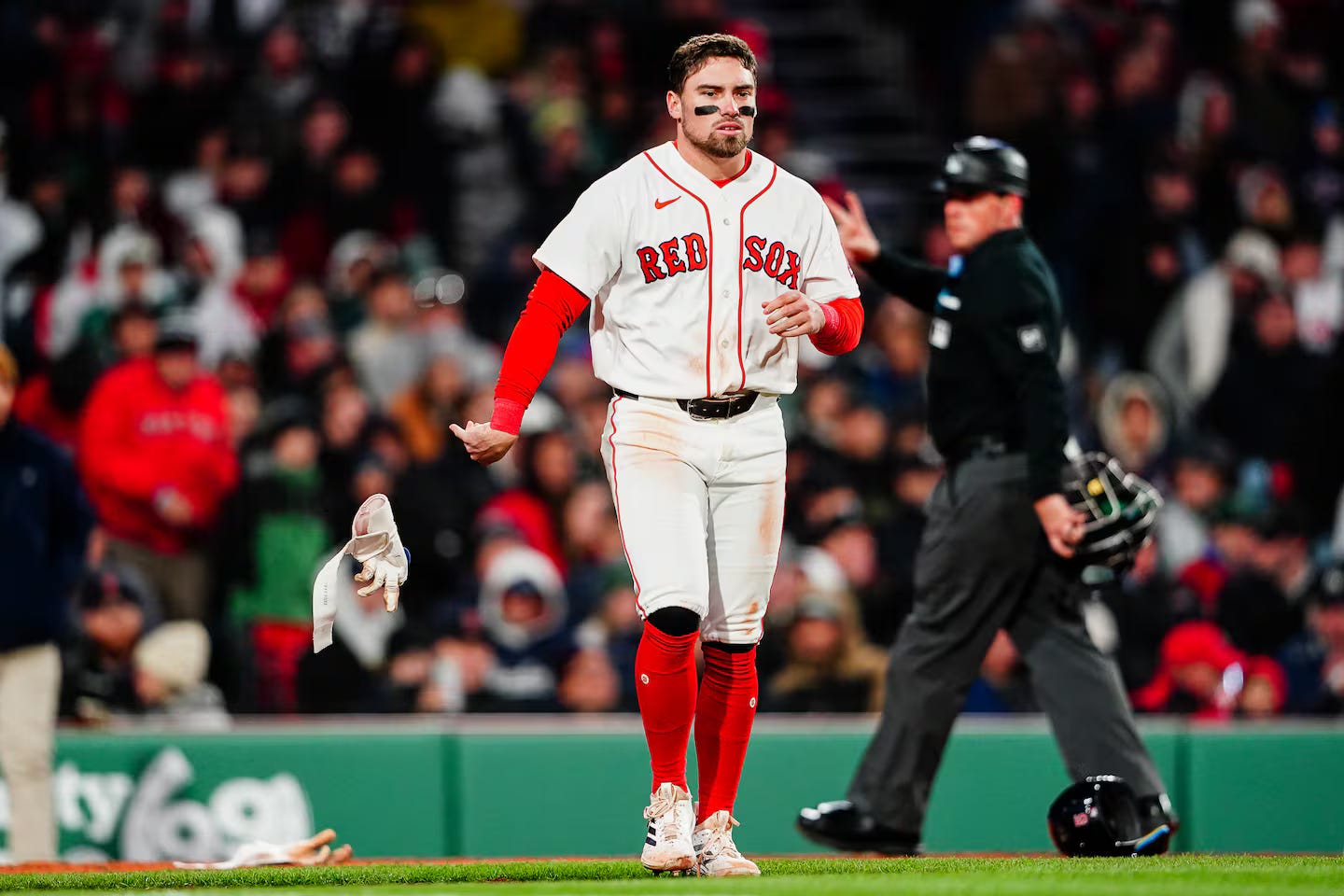
Would you pinch hit Madison Bumgarner for Caleb Durbin?
It’s a legitimate question.
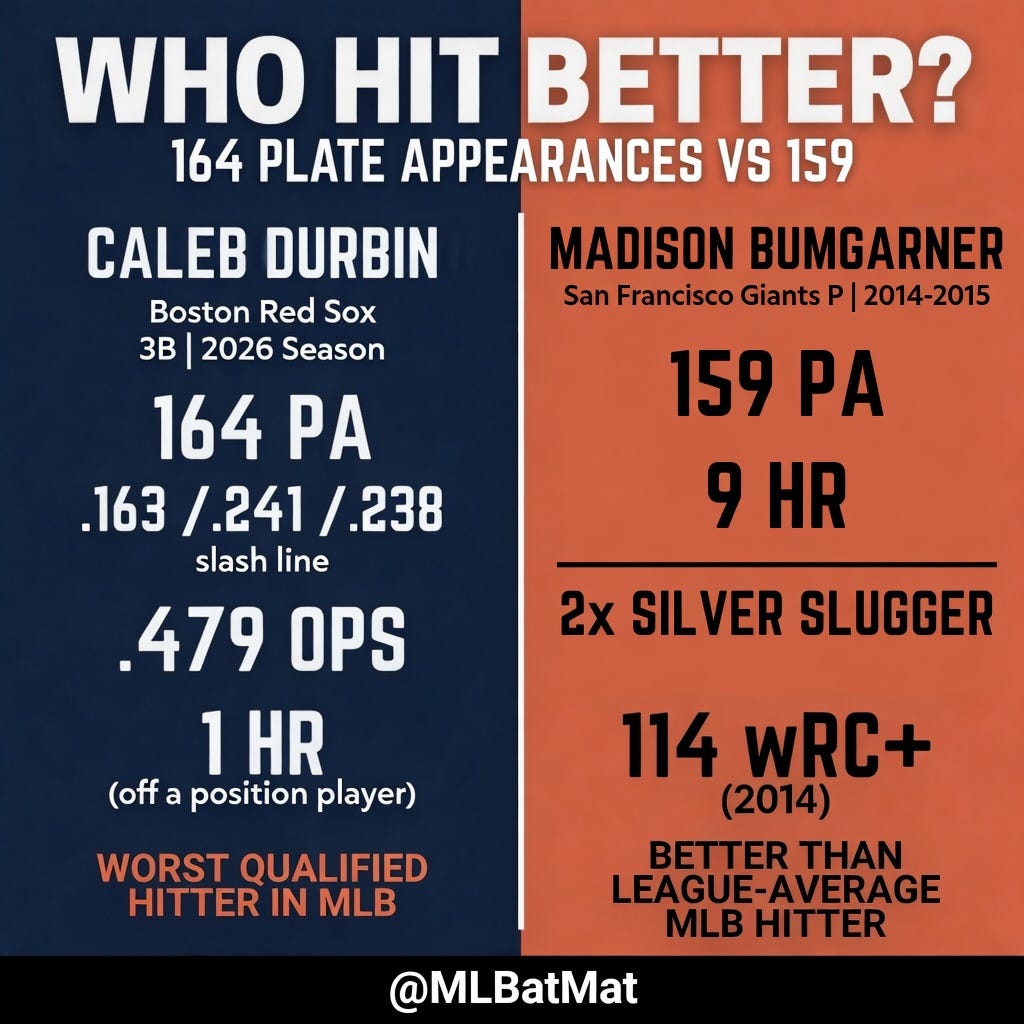
Caleb Durbin has 164 plate appearances this season.
In 159 plate appearances spread across 2014 and 2015, Madison Bumgarner hit nine home runs and won two Silver Slugger Awards.
Durbin is currently slashing .163/.241/.238 with a .479 OPS. That is the lowest mark of any qualified hitter in Major League Baseball. Not the worst on the Red Sox. Not the worst at third base. The worst in the entire sport. He has driven in 16 runs, scored 14, and stolen four bases. The Red Sox are paying him to be their everyday third baseman, and he is being out-produced by half the bench bats in the league.
That .479 is not just the worst in baseball this year, though. It is the second-worst OPS in Boston Red Sox history by any hitter with at least 150 plate appearances. Ever. Since 1901.
The only Red Sox hitter to ever post a lower OPS over a sample that size is Allen Craig, the former Cardinals All-Star and World Series champion who arrived in Boston in 2014 in the John Lackey trade. Craig hit .139/.236/.197 across 65 games before the team ate the rest of his contract and demoted him to Pawtucket. He is one of the most-cited Red Sox trade busts of the past 20 years. His name is what fans reach for when a front office gets too clever in a sell-off.
That is who Caleb Durbin is being measured against. The rest of the names within striking distance on that all-time leaderboard are mostly backup catchers and utility infielders who were never paid to hit in the first place. Marc Sullivan, third on the list, was on the roster in the 1980s largely because his father, Haywood Sullivan, was the team’s general manager and co-owner. The list is broken stars, owner’s sons, and bench bats. Caleb Durbin, the starting third baseman of the 2026 Boston Red Sox, is currently second on it.
Worth noting, too, that Allen Craig and Caleb Durbin came to Boston the same way. Trades with NL Central clubs. Craig from the Cardinals in July 2014, Durbin from the Brewers last offseason. Craig at least arrived with a 2011 World Series ring and a 2013 All-Star nod. Durbin has neither. To be fair, it is only his second year in the league. The hardware can still come. The bat? Time will tell.
Allen Craig had a foot injury. Marc Sullivan had a last name. Caleb Durbin has Craig Breslow.
Durbin has hit one home run on the season. One. It came in the ninth inning of a 17-1 blowout on April 25, off Orioles position player Weston Wilson. Yes, a position player. Yes, in a 17-1 game. That same Saturday afternoon, Craig Breslow flew to Baltimore to fire Alex Cora.
So Caleb Durbin’s only home run of 2026 is permanently fused to the death of the Cora era. It came off an outfielder pitching in mop-up duty. If you wrote this in a movie nobody would buy it.
Now to Madison Bumgarner.
In 2014, Bumgarner had 78 major league plate appearances and slashed .258/.286/.470 with four home runs and 15 RBI. His weighted runs created plus, the all-in-one offensive metric that scales to league average at 100, came in at 114. Read that again. A starting pitcher was 14 percent better than the average MLB hitter. He won the Silver Slugger Award. He did it again in 2015. 81 plate appearances, .247/.275/.468, five home runs, 104 wRC+, second consecutive Silver Slugger.
Add those two seasons together and you get exactly 159 plate appearances. Caleb Durbin needed five more than that to slug .238 with a single home run off a guy who plays the outfield. Across those 159 PAs, Madison Bumgarner hit nine home runs off actual major league pitchers and got two trophies for it.
A starting pitcher would be a lineup upgrade. That is not hyperbole. That is the truth.
And it gets worse. Mike Hampton hit .291 with seven home runs in 79 at-bats for the 2001 Rockies. Carlos Zambrano slashed .337 with four homers in 2008. Micah Owings posted a 1.033 OPS as a rookie pitcher in 2007. Bartolo Colon, at age 42, in a body that should not have been allowed to swing a bat in a major league game, hit a 365-foot home run off James Shields and gave the world the call of the century. None of these guys were paid to hit. They only picked up a bat because the National League had not yet conceded on the universal DH. They still produced seasons that would smoke Durbin’s current line.
You want to keep this Boston, though? Fine. Let’s keep it Boston.
Jon Lester had the worst career-opening stretch in the modern record. He went 0-for-66 to start his career as an American League starter, a futility mark that still stands. His lifetime hitting line came out to .075/.105/.087, anchored almost entirely by his Red Sox years when he was barely allowed to swing the bat. But then he got to the National League with the Cubs, and the man eventually figured it out. He picked up 16 career hits. He won a regular-season game with a perfect squeeze bunt in extra innings against Seattle. And on August 1, 2017, in his 197th major league at-bat, he turned on a 2-2 fastball from Patrick Corbin and yanked a two-run shot to left-center at Wrigley. Off a real starting pitcher. In a regular-season game that counted.
Josh Beckett, meanwhile, was given roughly four chances per year to swing the bat during interleague play and was generally not great at it. He finished his career with three home runs total. The first one as a Red Sox, on May 20, 2006, came off Brett Myers of the Phillies, a 14-year major league veteran with 97 career wins. It was the first home run by a Boston pitcher since Marty Pattin in 1972, a drought of nearly 35 years that spanned the entire DH era. Beckett, in a body that was paid to pitch and to do nothing else, took a real big-league starter deep.
Two of the worst-hitting pitchers in modern Red Sox memory. Both homered off actual major league pitchers when given the chance. Caleb Durbin is paid to hit. His one home run came off an outfielder in mop-up duty.
And here is where it gets surreal. Beckett’s career OPS as a Red Sox hitter was .538 across 40 plate appearances. Higher than Caleb Durbin’s right now. He is not even alone. John Lackey, in 15 plate appearances as a Red Sox, slashed .231/.231/.385 for a .615 OPS. Curt Schilling, over 11 plate appearances, hit .273/.273/.273 by just refusing to do anything other than slap singles. Three Red Sox starting pitchers, in a combined 66 plate appearances across their entire Boston careers, all posted higher OPSes than the team’s current starting third baseman has across 164.
And then there is Payton Tolle. The Red Sox rookie left-hander. At Wichita State, Tolle was a Baseball America All-American utility player and a John Olerud Two-Way Player of the Year finalist. He started 43 games at first base and 23 at designated hitter. As a sophomore in 2023 he slashed .311/.361/.538 with 13 home runs and 50 RBI in 55 starts. His college slugging percentage was more than double what Caleb Durbin is currently slugging in the major leagues. If the universal DH were on hold for one game tomorrow and Tolle had a bat in his hands, there is a real chance he would outhit your starting third baseman.
Congratulations, Caleb. You are somehow on the wrong side of comparisons to Jon Lester, Josh Beckett, John Lackey, and Curt Schilling. Every single one of them is a pitcher.
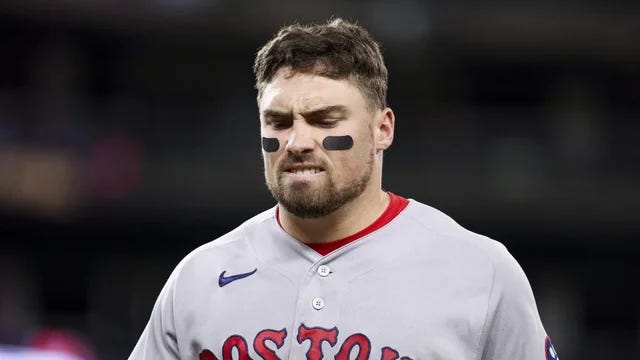
To his credit, the glove is real. Fangraphs has Durbin in the 85th percentile for fielding run value at third base, and Baseball Reference has him at a positive 0.4 WAR for the season. That is right. The worst qualified hitter in baseball is somehow still a positive-value major leaguer. Pure defense. He is single-handedly proving that a third baseman who barrels less than 2 percent of his batted balls can still be worth one-tenth of a win every two weeks if he fields his position well enough.
And that 0.4 is exactly why Craig Breslow keeps running him out there. It is the front office’s permission slip. As long as the WAR stays positive, the trade isn’t dead, the profile isn’t dead, and the bet isn’t dead. The numbers say “defensible.” The eye test says “Nick Sogard, please.” Breslow is going to keep choosing the numbers. Smh.
There is a version of this player, the one the Brewers had last year, who hits .256 with double-digit homers and provides legitimate value at the hot corner. The Brewers traded him to Boston and immediately watched the trade pay off, just not on the side everyone expected. Kyle Harrison, Shane Drohan, and David Hamilton went the other way. Harrison is currently striking out the side in Chicago. Hamilton is healthy. Drohan is on a major league mound. The Brewers got a future. The Red Sox got a defensive specialist hitting .163.
Caleb Durbin is what happens when a front office falls in love with a profile instead of a player. Contact rate, defensive versatility, baserunning, low strikeout numbers, all the analytical green flags. Then he showed up at Fenway and the league figured out in three weeks that you can throw him fastballs and he cannot do anything with them. His average exit velocity is 84.8 mph. His hard-hit rate is 28.2 percent. His barrel rate is 1.6 percent. The league average is around 8 percent. This is not a slump. This is a profile that does not survive contact with major league pitching.
Nick Sogard has been starting at third over Durbin in a quiet rotation that everyone in Boston can see but nobody in the front office will name. The fans at Fenway have started booing. Durbin acknowledged it this week, saying he cares about the team and is not playing to his capabilities. Fair. Nobody is questioning his effort. But effort and exit velocity are different things, and the Red Sox cannot keep running him out there hoping the swing finds itself when the contact metrics say there is no swing to find.
Meanwhile, Boston is 22-31, last in the AL East, four games out of a wild card spot. Trevor Story just had surgery and will not be back until July at the earliest. Roman Anthony is hurt. Garrett Crochet is hurt. The lineup is a mess. And every fifth day, Madison Bumgarner could have walked up to the plate at Fenway and given this team more production than they are currently getting from their starting third baseman.
We would have been better off with a pitcher in the lineup.
That sentence should not be sayable in 2026. We have the DH in both leagues. The pitcher-as-a-hitter is dead. And yet here we are, in May, looking at the Red Sox third base situation and genuinely asking whether Madison Bumgarner, age 35, retired for two seasons, with four All-Star nods, three World Series rings, and a World Series MVP collecting dust on a shelf in North Carolina, could not still walk up to the plate at Fenway tomorrow and post a .479 OPS.
The answer is probably yes.