


By: Chris Felico
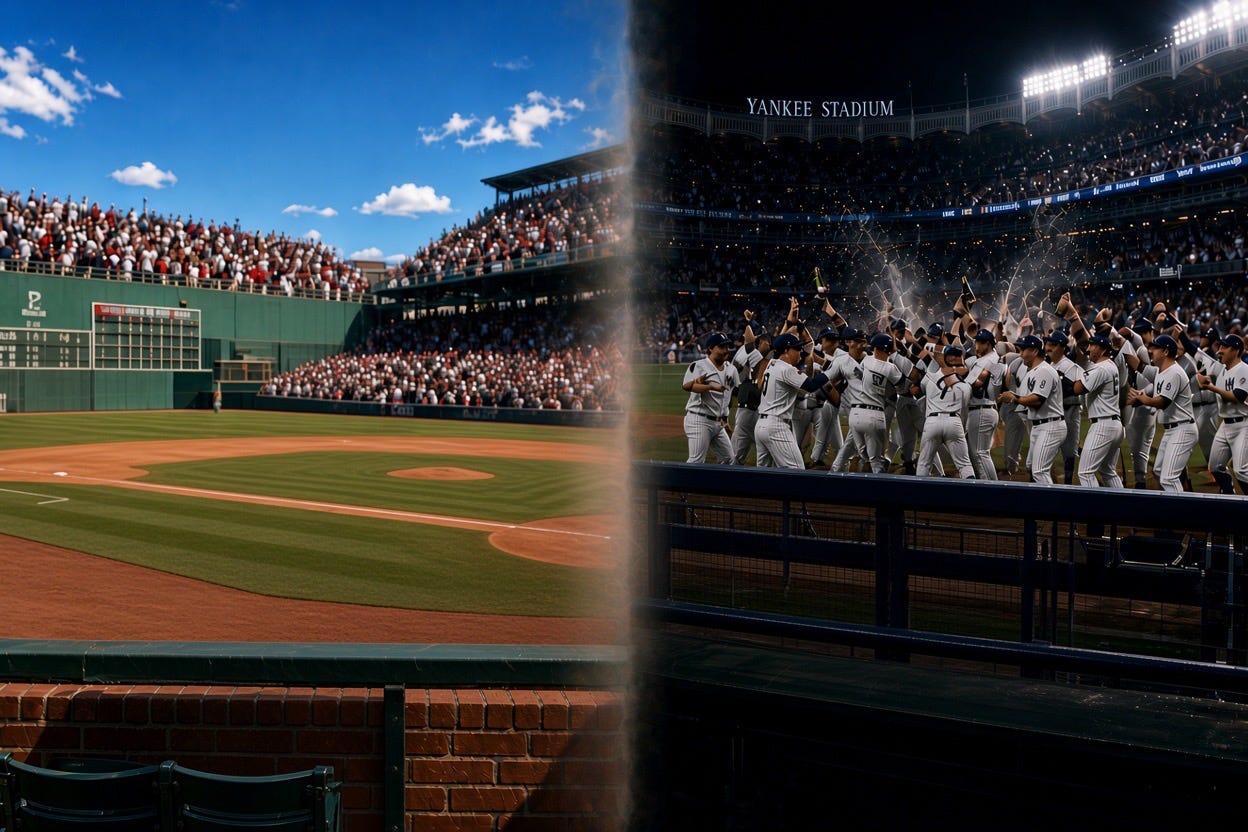
The Red Sox spent the summer convincing everyone that their season had been resurrected. After falling to 32-46, Boston ripped off an absurd 32-5 stretch from June 25 through August 7, including a franchise-tying 15-game winning streak. It was one of the most remarkable turnarounds the organization had seen in years. For a moment, it felt as if the season had been transformed from a disaster into something special. But baseball, particularly October baseball, has a brutal way of putting everything into perspective. The Red Sox didn’t win the division. They didn’t win a playoff series. They didn’t even win a postseason game. Instead, they were swept by the Yankees, 18-2 over two games, ending their season exactly where it ended a year ago: at the hands of their archrival.
And that is the uncomfortable truth about the summer: it didn’t matter when it mattered most. The 32-5 run was extraordinary, but it ultimately bought Boston two more games against the Yankees and nothing more. The Red Sox had spent months digging themselves out of a hole, only to arrive in October and look completely overwhelmed. Last year's postseason loss to New York went three games; this year's lasted two. Garrett Crochet, who was instrumental in last year's playoff victory over the Yankees, couldn't even make his 2026 postseason debut until Game 2 after spending nearly the entire season on the injured list. And, when he got his opportunity as a reliever in a 2-1 game, it was evident that he hadn’t pitched in over five months. The summer was fun. It was dramatic. It was memorable. But the objective of a baseball season isn't to create the best story in July. It is to still be standing when October ends.
Worse, there is an argument that the spectacular comeback actually made the larger failure more consequential. Had Boston remained buried at 32-46, the organization would have been forced to confront its flaws much earlier. Instead, the winning streak transformed a lost season into a referendum on the roster, the front office and the direction of the franchise. Suddenly, the Red Sox were buyers, contenders and believers. Craig Breslow pushed chips into the middle at the trade deadline, acquiring Adley Rutschman and other pieces while spending significant prospect capital. The organization was rewarded with a playoff berth—but the prize was another early exit to the Yankees. The comeback therefore didn't simply fail to produce a championship; it may have delayed the reckoning that was necessary to determine whether this roster was actually constructed to win in October.
That brings us to the philosophy behind the operation. Boston has increasingly leaned into an analytical, efficiency-driven approach, trying to find value and build intelligently rather than simply overwhelming the competition with pure payroll and proven talent. There is nothing inherently wrong with analytics—every serious organization uses them—but Moneyball has never really been about proving that cleverness is more important than talent. In a big market, the expectation isn't merely to find inefficiencies. It is to turn those advantages into championships. And after two consecutive postseason eliminations by New York, the question becomes unavoidable: what exactly has this approach produced? The Red Sox have now spent two years building toward October only to have the Yankees erase them before the Division Series. Even worse, Chicago's historically ugly recent stretch has now produced a playoff series victory sooner than Boston's post-Crochet era, an absurd comparison that nevertheless captures the frustration surrounding where the Red Sox currently stand.
The American League was there for the taking, too. Boston didn't have to navigate some unbeatable juggernaut standing in its way. The league was remarkably open, and the Red Sox demonstrated during that 32-5 stretch that they were capable of playing dominant baseball. That's what makes the ending so difficult to accept. They showed us what this team could look like at its absolute best—and then showed us that its best wasn't nearly enough. The Yankees, meanwhile, remain the measuring stick Boston cannot escape. New York took seven of the 13 regular-season meetings and then eliminated Boston in consecutive postseasons. Whatever happened during those magical weeks of summer, the only rivalry result that will survive in the record books is the one that sent the Red Sox home.
There is a line in Moneyball that feels almost painfully appropriate here: “If we don't win the last game of the Series, they'll dismiss us.” That's the cruel bargain of professional sports. Nobody can take away what those players accomplished between June and August. Nobody can erase the feeling of watching a 32-5 team emerge from what looked like an impossible hole. But history doesn't preserve regular-season winning streaks the way fans remember them in the moment. It preserves champions, pennant winners and postseason moments. The 2026 Red Sox created a generational summer, but they didn't create a championship. And after losing to the Yankees for the second straight year, the question isn't whether that summer was real—it absolutely was. The question is whether it ultimately meant anything. In the annals of baseball history, the answer may be painfully simple: not nearly enough.