


By: Chris Felico
The Boston Red Sox are stuck.
Not quite rebuilding, not truly contending. Not a small-market team by finances, yet playing the part far too convincingly. Caught in the mire of inconsistency and mediocrity, the Red Sox find themselves in a familiar position: asking big, uncomfortable questions about the face of their franchise.
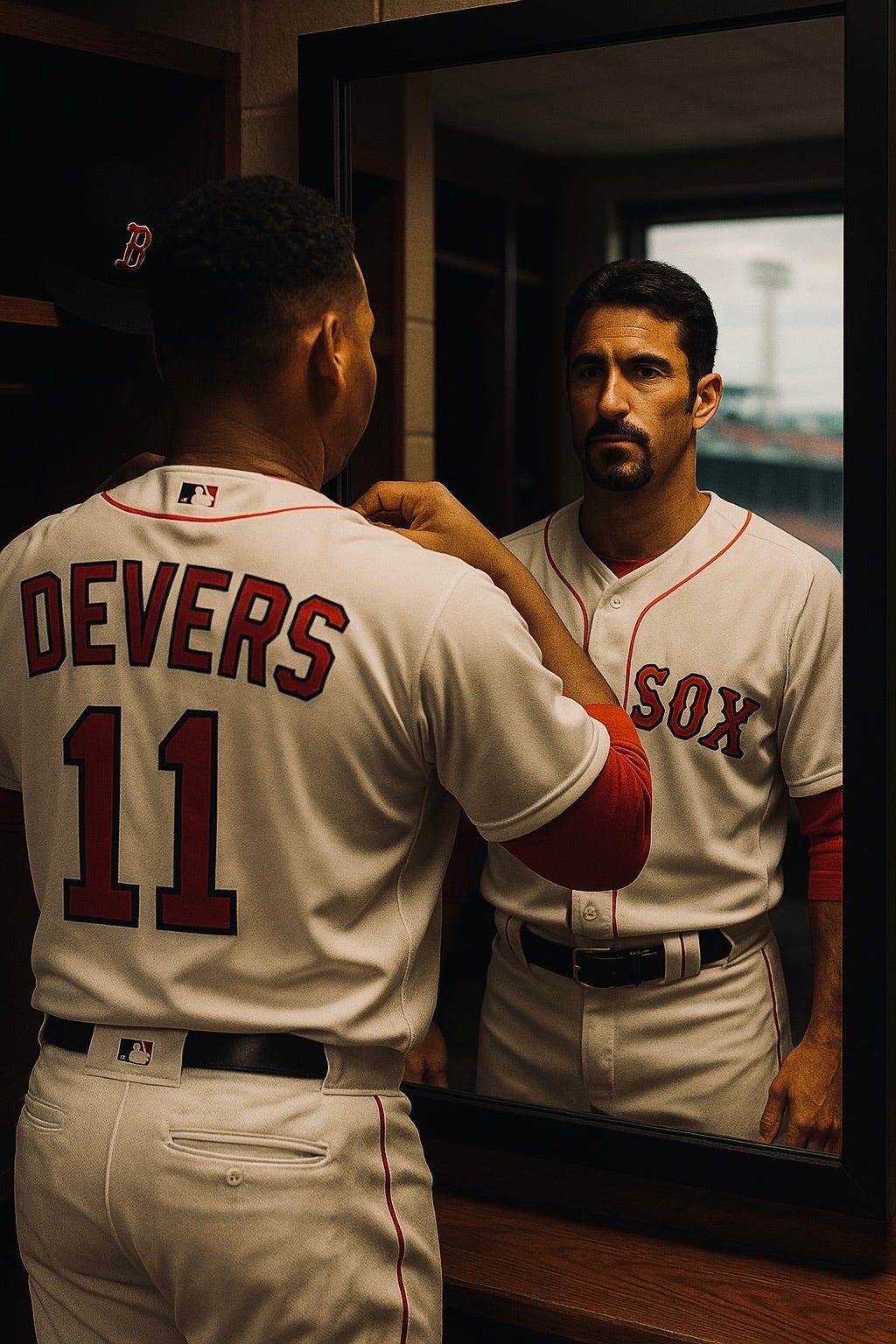
And maybe the biggest one of all: Should they trade Rafael Devers?
It’s a thought that once felt unthinkable. Devers, the prodigious left-handed bat with generational power to all fields, has long been the crown jewel of Boston’s post-2018 core. But here we are in 2025, and the numbers—and the results—speak for themselves. Since Devers became the centerpiece of the lineup and face of the franchise, the Red Sox have done more losing than winning. Playoff appearances have been sparse, direction inconsistent, and leadership—at least the vocal, tone-setting kind—has been conspicuously absent.
Devers is an elite hitter, no doubt. But he’s not the leader this team needs. And as frustrations mount amid another season of underperformance and a clubhouse that feels more rudderless than resolved, it begs the question: could a bold, course-changing trade be what Boston truly needs?
It’s impossible not to draw a parallel to one of the most seismic moments in Red Sox history: the 2004 trade of Nomar Garciaparra.
That trade shocked the baseball world. Nomar, a franchise icon, was sent packing midseason in a move that had little to do with his production and everything to do with the dynamics around him. He was unhappy. He refused to play through injury. The chemistry was off. Theo Epstein saw it. The front office made the painful call. And it paid off. The Sox ripped off a historic postseason run and broke the 86-year curse to win it all.
But that 2004 trade was about winning now. Boston had just suffered a soul-crushing ALCS loss to the Yankees on Aaron Boone’s walk-off. The roster was this close. That move wasn’t just about Nomar—it was about alignment, chemistry, urgency.
A Devers trade in 2025 would be about something else entirely: changing culture.
This isn’t a team knocking on the door of a championship. This is a team grasping for identity. And instead of rising to that challenge, Devers seems more concerned with proving a point—whether it’s about his contract, his role, or the arrival of Alex Bregman than about leading a team desperate for a spark.
It’s telling. With Bregman sidelined, instead of Devers seizing the moment to elevate his game, to lift the team on his shoulders, we’ve seen more of the same: inconsistent energy, uneven at-bats, and body language that raises more questions than answers. He’s paid like a cornerstone, but performing—and carrying himself—like a man watching from the shadows.
That’s the difference. Nomar resisted leadership. Devers seems disinterested in it altogether.
So what would a Devers trade do?
In the short term: It would shock the system. It would reset the tone from the top down. It could open doors to acquire high-level prospects, clear significant payroll, and give the front office the flexibility to reimagine the roster—especially in a system that now punishes bloated, underperforming payrolls. However, it also removes what has been the franchise’s most deadly bat in the lineup for almost the last decade.
In the long term: It could be the bold stroke that redefines the next era of Red Sox baseball. A necessary pivot. A culture cleanse. And yes, it might hurt—emotionally and competitively. But isn’t the current trajectory painful too?
Of course, this all assumes the front office has the conviction—and vision—to make such a move and then build around it. That’s no guarantee. But continuing down the current path, hoping Devers transforms into something he’s never shown a consistent willingness to be, seems even riskier.
So we’re left with the question:
Should the Red Sox trade Rafael Devers?
And if they do, is it a step backward—or the first real step forward this franchise has taken in years?
The answer, like Devers' own evolution, remains uncertain. But one thing is clear: the status quo isn’t working. And change, uncomfortable as it may be, might be the only way back to the top.