


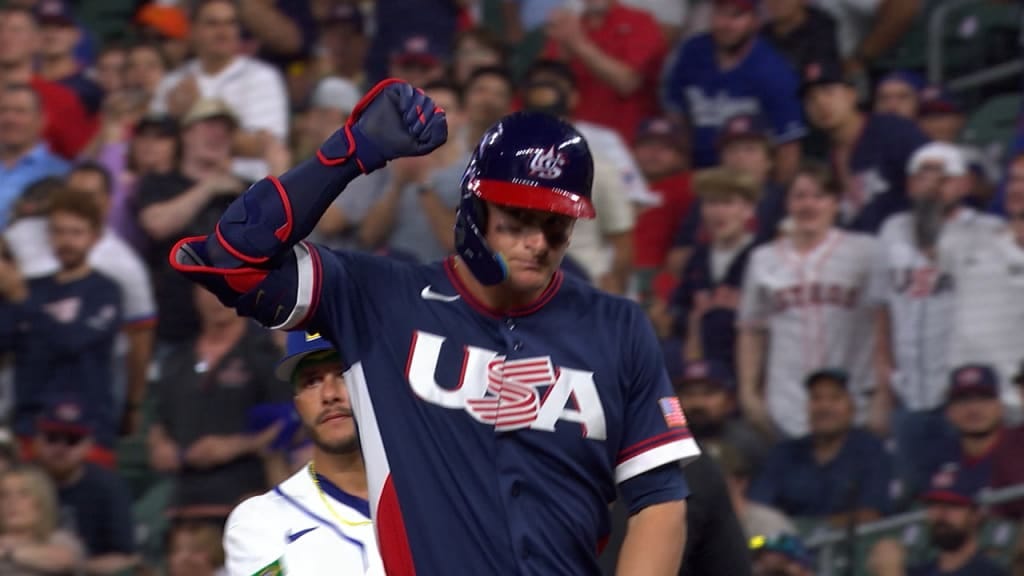
In Team USA’s first game in the World Baseball Classic, which they won 15-5, the team took 17 walks, which is a staggering number for nine innings. Eight of the nine players in the lineup had on-base percentages of .350 or higher in 2025 (this number is my completely arbitrary threshold for what I consider an elite on-base player). These are some of the best hitters in major league baseball. Is it a coincidence that they also get on base at a staggering clip? I don’t think so.
We all read the book or saw the movie. Billy Beane built a team for the 2002 season primarily based on OBP. This was the only way he could find players that fit into the team’s budget, which was miniscule. Scott Hatteberg, Jeremy Giambi, and David Justice were the focus of the movie, but in reality, that team had 7 hitters with an OBP of .350 or greater.
That team won 103 games including an AL record 20 in a row. None of these players went on to be Hall of Famers, mind you, but guys like Miguel Tejada and Eric Chavez had pretty good careers. Why is OBP important? There are so many other important metrics 24 years after Moneyball. There is WAR, wRC+, hard hit percentage, barrel rate, chase rate. It goes on and on. Just look at a Savant page.
OBP is more than just taking walks. When Theo Epstein was installed as the general manager of the Red Sox in 2003, he was obsessed with OBP. At the time, he felt (as Beane did) that it was the most important statistic in baseball. He inherited a few elite OBP guys in Manny Ramirez (thanks to Dan Duquette) and Trot Nixon. Over the years, he added some of the greatest on base players in Red Sox history: David Ortiz, JD Drew, Kevin Youkilis, Adrian Gonzalez, and Dustin Pedroia to name a few.
Here is a chart of the “elite” OBP players during the five front offices since John Henry has owned the team (minimum 50 games):
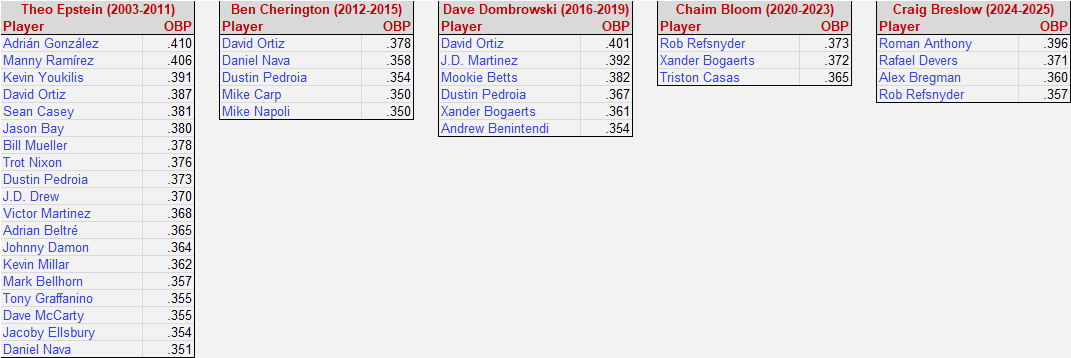
Theo’s obsession with OBP is clear. He also won two World Series. Ben Cherington’s best acquisition was Mike Napoli, and he was a key piece to the 2013 championship. Dave Dombrowski inherited some great hitters, but it was his acquisition of J.D. Martinez that put the 2018 team over the top.
Since 2019, the focus of getting on base seems to have waned. Betts, Martinez, Bogaerts, and Devers are gone. The focus now seems to be bat speed, launch angle, and pulling the ball. Of the four players under Breslow that I would consider elite on base players, three are gone for 2026. Epstein continued his focus on OBP when he built the Cubs 2016 championship squad. Anthony Rizzo, Kris Bryant, and Kyle Schwarber were all OBP monsters. There was this other guy that Theo got, a catcher from Venezuela, who went on to have a very good career including an OBP of .352. That guy is Willson Contreras and he is now the starting first baseman for the 2026 Red Sox. This gives me hope.
So now the answer to the question you’re all asking. Why is OBP so important? Why can’t a hitter be great just by swinging away? There are some that can, but a player who has a high OBP also has something else, patience and a very good batter’s eye. Ted Williams used to ask his teammates “what’s he gonna do to get you out?” Ted’s brain was the first video analysis machine. Hitters today have no excuse not to have a plan against a specific pitcher when going to the plate. There are even pitching machines (Trajekt) that can mimic any given pitcher’s pitches. Why would you swing at a pitch if you know you can’t do anything with it?
The 2026 Red Sox have some players that need to improve their plate discipline. First and foremost is Ceddanne Rafaela. He’s accumulated only 47 walks in 3 seasons with an OBP of .284. Wilyer Abreu showed huge promise in the early part of his career as a patient hitter. He needs to get back to that. If Jarren Duran raised his OBP he would be that much more dangerous on the base paths.
There are many things that the 2026 Red Sox need to do better such as hitting home runs, playing defense, and situational hitting, but I’ll just go ahead and say it. If they can be more patient at the plate as a team, good things will happen. With more “ducks on the pond” a key hit here or there will produce great results. Better pitch recognition will cut down on strikeouts and increase walks. My fear is that these concepts are just not emphasized by the team. “We are going to hit the ball hard and in the air” is actually a sign posted in Spring Training.
My hope is that the young Roman Anthony and the veteran Willson Contreras can set an example for the rest of the team. Just watch Team USA’s plate appearances. They are a master class in hitting.
Loving the Team USA squad at the moment. Great note on the philosophical shift for the Sox as it is clearly led by things like bat speed. The OBP obsession still runs across baseball now and a big reason why modern metrics have been invented, just to see and illustrate how important the guy “who takes his walks” is to his team’s success.